
How AI Improves First Response Time in Helpdesks
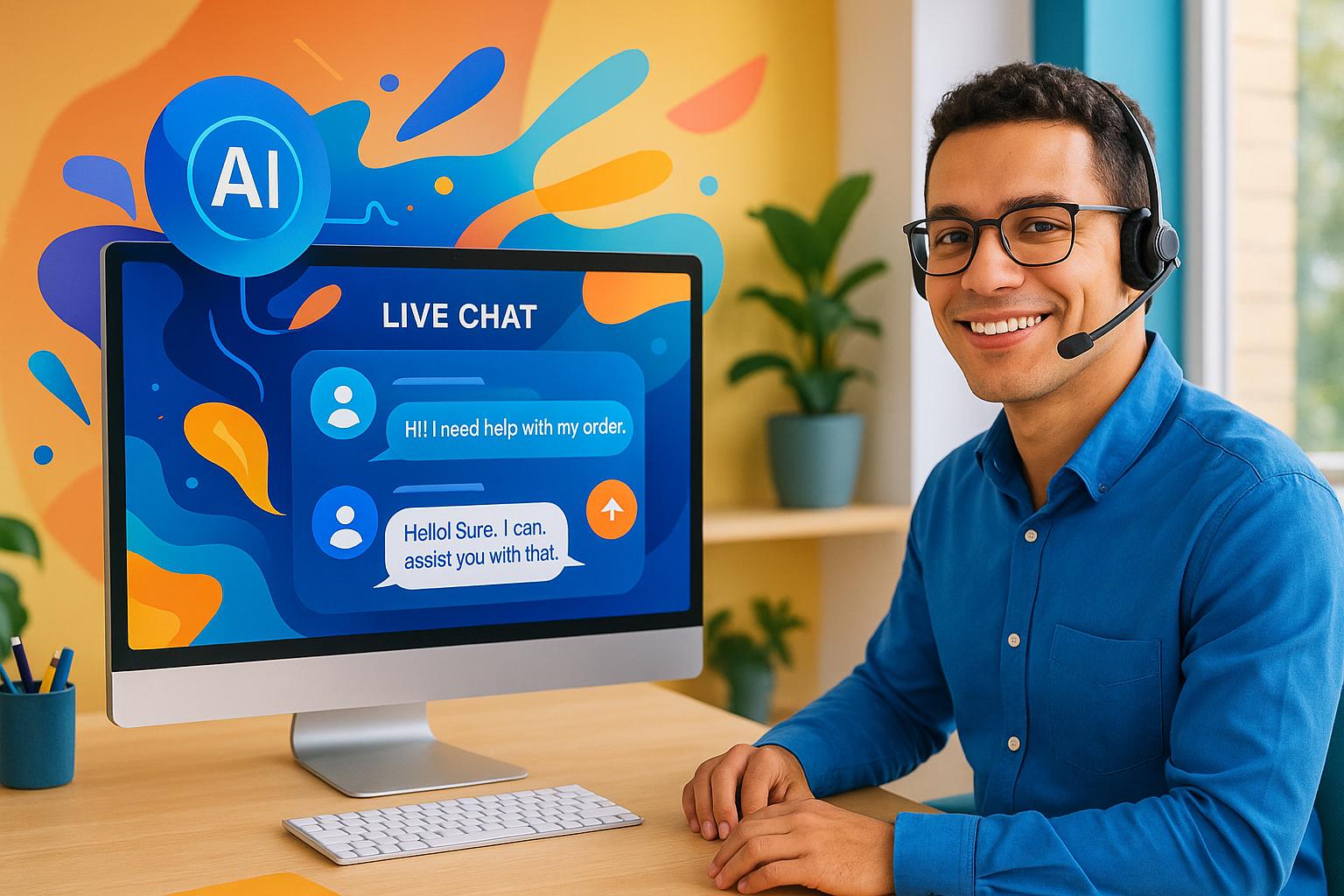
AI has transformed helpdesk response times, cutting delays from hours to seconds. By automating routine tasks, it ensures customers receive instant acknowledgment, improving satisfaction and reducing operational costs. Businesses using AI report:
AI chatbots handle repetitive queries, provide 24/7 support, and seamlessly hand off complex cases to human agents with full context. Tools like AI-powered knowledge bases and ticket routing systems further optimize operations. The result? Faster responses, happier customers, and significant cost savings.
Help Desk AI: How AI is Transforming Help Desk Support
What Is First Response Time and Why It Matters
First response time (FRT) measures how quickly a customer receives an acknowledgment or reply after submitting an inquiry to your support team or AI system. Importantly, this metric focuses on the time it takes to provide that first acknowledgment - not the time it takes to fully resolve the issue.
Think of it like knocking on a door: would you rather hear an immediate "Hello, how can I help you?" or stand outside waiting, unsure if anyone’s there? A fast acknowledgment shows customers that their time matters. It sets the tone for their entire support experience and reassures them that their issue is being addressed.
FRT applies across various channels - email, live chat, phone, social media, and messaging apps. While customer expectations differ by channel, the core principle is the same: people want to know their issue has been noticed and that help is on the way.
Unlike resolution time, which can vary based on the complexity of the problem, FRT is something you can control. Whether it’s a quick billing question or a complex technical issue, the speed of your first response reflects the efficiency of your support system. And when done right, it becomes a major factor in boosting customer satisfaction and operational efficiency.
The Business Impact of Fast Response Times
Quick acknowledgments don’t just improve the customer experience - they have a ripple effect across your business. When customers feel heard right away, they’re more likely to trust that their issue is being handled. This confidence translates into higher customer satisfaction (CSAT) scores.
The data backs this up. Companies using AI-powered support tools have seen 15-25% improvements in CSAT scores within six months. For example, one gaming company reduced its first response time by 86%, achieving a strong 4.3 CSAT score. Another business saw satisfaction rates jump from 72% to 89% after introducing AI, while also cutting their churn rate from 4.2% to 2.8%.
The financial benefits are just as striking. Businesses using AI report a 37% drop in first response times, with some achieving reductions as high as 55%. These improvements boost ticket deflection rates by up to 60%, double or even triple productivity for agents handling complex issues, and cut resolution times by as much as 60%.
On the flip side, slow response times can have serious consequences. Customers who don’t receive a timely acknowledgment often abandon their inquiries and take their business elsewhere. Delays lead to frustration, which can result in negative reviews and bad word-of-mouth. In competitive markets, slow responses can be the deciding factor that pushes customers to switch to a competitor.
For subscription-based businesses, this can directly increase churn rates. In e-commerce, it impacts conversion rates and leads to higher cart abandonment. Over time, these issues force companies to spend more on acquiring new customers while reducing the lifetime value of existing ones - both of which hurt profitability.
Standard Response Time Benchmarks by Channel
To understand why fast FRT is so critical, let’s look at the expectations customers have for different support channels. These benchmarks highlight the varying demands of each communication method. Real-time channels like live chat require immediate responses, while asynchronous options like email allow for slightly longer windows.
Live Chat
Under 1 minute
Immediate help during a live conversation
Email & Web Forms
Under 1 hour
Acknowledgment within business hours
Phone/Call Centers
80% of calls within 20 seconds
Quick answers with minimal hold time
Social Media
Under 1 hour
Fast responses to maintain public trust
AI tools are now helping businesses exceed these benchmarks. For example, AI chatbots can deliver responses in under one second. Traditional email support, which typically takes 12–24 hours, can now be reduced to just 2 hours with AI. Live chat response times have dropped from 8 minutes to 30 seconds. Some companies have even slashed their first response time from over 6 hours to under 4 minutes.
Real-world examples further illustrate this shift. AkzoNobel cut its average response time from nearly six hours to just 70 minutes by adopting AI solutions. Tinybird reduced its first response time from 1 hour to 12 minutes, while Voltage Park brought theirs down from over an hour to just 3 minutes. These aren’t isolated cases - they represent a growing trend in what’s achievable with AI-driven support.
It’s also worth noting how customer expectations are evolving. People no longer compare your service to others in your industry - they compare it to their best experience anywhere. If their bank’s chatbot responds instantly, they’ll expect the same speed from your e-commerce store. This rising standard means keeping up with yesterday’s benchmarks isn’t enough. To stay competitive, you need to surpass them.
How AI Chatbots Reduce First Response Times
AI chatbots have transformed the way businesses handle customer inquiries, slashing the time it takes to deliver a first response. Instead of waiting minutes - or even hours - for a human agent, customers now receive instant acknowledgment as soon as they reach out. This immediate reaction eliminates those frustrating silent waits and reassures customers from the very start.
To put it into perspective, while email support might take 12–24 hours and live chat averages about 8 minutes, AI chatbots respond in under a second. That’s a staggering 97% faster than traditional methods. This speed comes from the efficiency of automation - AI chatbots don’t get bogged down by multitasking, don’t need breaks, and aren’t overwhelmed by surges in ticket volume. They’re always available, ready to engage at lightning speed, paving the way for more detailed interactions.
This dramatic improvement in response times has had a direct impact on business performance. Some companies have reduced their average response times from over 6 hours to less than 4 minutes. Email support times have also dropped significantly, from 18 hours to just 2 hours on average. Even phone support now benefits, with AI-powered voice agents handling 87% of calls instantly.
Instant Acknowledgment and Query Handling
The moment a customer submits a query, an AI chatbot springs into action. It greets the customer, acknowledges their concern, and starts gathering relevant information - all within seconds.
But it doesn’t stop there. AI chatbots take the conversation further by asking targeted follow-up questions. For example, a chatbot assisting with a car service inquiry might ask, “Can you share your car model and preferred service location?” This helps determine whether the issue can be resolved automatically or if it needs to be escalated to a human agent.
For routine inquiries, AI chatbots often deliver complete answers without human involvement. They can handle over 45% of incoming queries, with some industries like retail and travel achieving deflection rates above 50%. In fact, AI systems resolving 90% of basic account-related queries have allowed human teams to save up to 15 hours of repetitive work per week. These chatbots draw from extensive knowledge bases, past interactions, and company data to provide personalized answers. They can instantly share help articles, check order statuses, retrieve account details, and guide customers through troubleshooting steps - often solving problems before a traditional support system would even acknowledge the ticket.
Aaron Valente, Director at
"Converso's AI agent has reduced the volume of insurance policy queries that the support team answer by at least 50%, through easy integration of our AI Agent with our sales support team. Together with the upcoming lead gen agent, AI has the potential to revolutionize our business!"
AI chatbots also excel at tailoring their responses. Using data from past interactions and purchase histories, they recognize individual preferences, past issues, and even optimal contact times. This level of personalization not only enhances efficiency but also strengthens customer satisfaction.
Smooth Handoff to Human Agents
While AI chatbots are great at handling routine queries, more complex issues require human expertise. That’s where a seamless handoff system comes into play. By blending the speed of AI with the expertise of human agents, businesses ensure that every customer concern is addressed effectively.
When a query needs human attention, the chatbot transfers the full context - conversation history, customer details, and any qualifying information - to the most suitable agent. This means customers don’t have to repeat themselves, allowing the agent to jump straight into solving the issue.
Intelligent routing systems analyze the nature of the query to determine not only if human intervention is needed but also which agent is best equipped to handle it. For example, urgent matters like payment problems or security concerns are escalated immediately to specialists, while routine questions are queued appropriately. For pre-sales inquiries or high-value leads, the system can instantly connect customers to sales agents, ensuring no revenue opportunities are missed.
Companies using these AI-driven handoff systems have seen impressive results: 84% fewer transfers between departments and a 33% increase in first-interaction resolutions. When human agents step in, they’re already armed with detailed context, enabling them to focus entirely on resolving the issue. This combination of instant AI responses and expert human intervention creates a support experience that’s fast, efficient, and effective.
Solutions like Converso make this transition seamless by equipping human agents with unified customer histories and complete chat transcripts. Agents can join live conversations without requiring customers to open new tickets or re-explain their concerns. This ensures that even the most complex issues receive the personalized and attentive care they deserve.
AI-Powered Ticket Routing and Classification
AI has revolutionized customer support by not only providing instant responses but also streamlining ticket routing and classification. Traditionally, support teams had to manually sort and assign tickets - a process that often created delays and errors. Misrouted tickets meant longer wait times for customers and inefficiencies for support teams.
With AI-powered routing, these bottlenecks disappear. The system analyzes incoming inquiries as soon as they arrive, determining customer needs, identifying emotional cues, and assigning tickets to the most suitable agent in seconds - all without human input.
This approach dramatically reduces first response times, cutting wait times from minutes to mere seconds[2]. It also allows agents to handle complex issues more efficiently, boosting their productivity by 2–3×.
Real-Time Query Analysis
AI leverages natural language processing (NLP) to assess every aspect of a customer message simultaneously. It doesn’t just focus on keywords; it understands the full context, sentiment, and urgency behind the request.
Through NLP, the system identifies intent, tone, and urgency. For instance, it picks up on phrases like "urgent", "frustrated", or "still waiting" to flag messages requiring immediate attention. Urgency detection also recognizes critical issues, such as "system down", "payment failed", or "can't access", ensuring time-sensitive tickets are escalated quickly.
During high-demand periods - like holidays, product launches, or outages - AI ensures tickets are prioritized and routed efficiently, preventing the usual logjams.
The results speak for themselves. Tinybird reduced their first response time from 1 hour to just 12 minutes. Voltage Park cut theirs from over an hour to 3 minutes, and Kinde achieved a 40% reduction in response time by using AI-driven ticket classification and unified workflows[10].
Directing Tickets to the Right Team
Once AI determines the nature of a ticket, it routes the inquiry to the team or individual best equipped to resolve it. This process considers factors like the issue’s complexity, customer value, language preferences, and even real-time agent availability.
The system learns from past interactions, assigning recurring issues to agents with relevant experience. Critical matters - such as payment problems, outages, or security concerns - are escalated immediately to specialists, while routine requests are directed to self-service options or chatbots. High-value leads or pre-sales inquiries go straight to sales teams, ensuring no revenue opportunities are missed.
A gaming company saw incredible results after implementing AI-powered routing. Their time to first response dropped by 86%, reaching just 1 hour and 40 minutes. Additionally, 85% of player issues were resolved through automated channels, with a 95% automation deflection rate and an 80% boost in agent productivity
.
For businesses using platforms like Converso, AI integrates seamlessly with shared team inboxes that consolidate communication channels, such as webchat, WhatsApp, and SMS. Departments can have dedicated inboxes, ensuring that billing queries go to finance, technical issues to IT, and sales inquiries to the right representatives. When human intervention is required, the system provides agents with the full conversation history, enabling them to resolve issues quickly and effectively.
The efficiency gains are impressive. AI routing can save teams 15–20 hours per week by eliminating manual ticket classification. It reduces unnecessary transfers between departments and increases the likelihood of resolving issues in the first interaction. Companies that adopt AI routing often see a 40–60% decrease in overall resolution time[6].
sbb-itb-e1b05dc
Using AI Knowledge Bases for Faster Responses
When customer service agents spend too much time hunting through outdated documents or scattered databases, response times inevitably take a hit. It’s not that agents aren’t eager to help - it’s that finding the right information can feel like searching for a needle in a haystack. That’s where AI knowledge bases come in, completely changing how support teams operate.
AI-powered knowledge bases eliminate the hassle of inefficient searches. They instantly surface relevant articles, past solutions, and suggested responses - right within the chat window. No more switching between tabs or digging through folders. This instant access means agents can deliver accurate answers quickly, cutting down the time customers spend waiting.
The difference in speed is remarkable. Companies using AI support tools have seen first response times drop from 15 minutes to just 23 seconds - a staggering 97% improvement [2]. Live chat teams, in particular, can now respond in under a minute [3]. AI systems are built to provide consistent answers that align with product updates, company policies, and customer preferences, minimizing human error - especially in high-pressure situations or when data access is limited [3]. With well-organized documentation, AI can increase resolution rates by 15–25%, and when integrated with CRM and billing systems, resolution rates improve by another 20–30% [2].
Instant Access to Articles and Solutions
AI knowledge bases work by analyzing customer inquiries in real time and retrieving the most relevant information from your documentation. For example, when a customer asks about resetting a password, billing details, or product features, the AI immediately presents the exact article or solution they need.
These systems are trained on your company’s specific product and business data, ensuring they provide precise answers to customer questions [1]. Agents can pull this information directly from the knowledge base or website, allowing them to respond instantly [1].
For more complex issues, AI suggests relevant articles, FAQs, or solutions directly within the chat interface. This allows agents to confirm the information before replying, ensuring accuracy without delay. The AI even uses customer history to deliver personalized, context-aware responses [6], making interactions more meaningful and effective.
AI can also handle straightforward queries on its own, like answering common product questions that customers might struggle to find on a website or datasheet [1].
At Key Health Partnership, Converso’s AI agent reduced insurance policy queries handled by human agents by at least 50%, thanks to seamless integration with their sales support team
.
Reducing Time Spent Searching for Information
AI doesn’t just retrieve information quickly - it also slashes the time spent on administrative tasks. For instance, AI can summarize customer conversations up to 60% faster, allowing agents to focus on crafting thoughtful responses rather than wading through notes [15]. It also saves teams 34% of the time typically spent generating responses from the knowledge base and 28% of the time spent expanding notes into full replies [8].
By automatically analyzing support tickets, AI identifies gaps in documentation, ensuring the knowledge base stays updated without requiring constant manual effort [7]. This means agents aren’t stuck verifying or correcting outdated information.
The time savings are significant. Teams using AI report a 45% reduction in call time and resolve issues 44% faster [8]. For example, AkzoNobel cut their average response time from nearly six hours to just 70 minutes by adopting AI-driven customer service solutions [8].
Platforms like Converso integrate AI knowledge bases seamlessly with shared team inboxes across multiple channels - webchat, WhatsApp, SMS, and more. This ensures agents have immediate access to the knowledge base and conversation history, no matter how a customer reaches out. The result? Faster resolutions without the need to juggle multiple systems.
These efficiency gains directly impact business performance. Teams using AI have seen Time to Resolution (TTR) drop by 40% or more through automated triage [6]. They also report 30% higher CSAT scores, 84% fewer departmental transfers, and 33% more issues resolved on the first interaction [6].
When AI handles 90% of basic account queries automatically, it frees up human agents from repetitive tasks, saving them 15 hours per week - all without sacrificing quality [6]. This allows agents to dedicate their time to solving complex problems that require a human touch, building on the speed and efficiency introduced by AI-driven chatbots and intelligent ticket routing.
The result is a customer support system that’s faster, more accurate, and better equipped to handle both simple and complex inquiries - while letting human agents focus on what they do best.
Providing 24/7 Support with AI
Today’s customers expect quick responses - whether it’s 2:00 PM on a weekday or the middle of the night on a weekend. Traditional support teams often struggle to meet this demand without significantly increasing payroll costs.
AI changes the game by offering uninterrupted support. It works around the clock without breaks, sleep, or shift changes. Businesses can achieve full after-hours coverage without hiring more staff, ensuring customers get answers whenever they need them. In fact, AI can reduce staffing needs by up to 68% during peak seasons and 51% throughout the year [5][8]. For global companies, a single AI system can handle customer inquiries across time zones, eliminating the need for local teams in every region.
One company introduced AI agents for both voice and text support and saw impressive results. Email response times dropped from an average of 18 hours to just 2 hours, while chat response times went from 8 minutes to 30 seconds. AI voice agents handled 87% of calls instantly, boosting customer satisfaction from 72% to 89%. Additionally, the monthly churn rate decreased from 4.2% to 2.8%, and the cost per support ticket went down by 35%. This implementation delivered measurable returns within the first quarter [11].
By operating continuously, AI creates an uninterrupted support system, seamlessly managing queries day and night.
Handling Common Questions Automatically
AI is especially effective at handling repetitive questions that often bog down support teams. Tasks like password resets, order tracking, billing inquiries, shipping updates, product details, and policy clarifications are resolved instantly - no human involvement required.
In the gaming industry, AI resolved 85% of player issues through automated messaging [4]. By automating routine tasks, businesses can deflect 40–60% of incoming tickets from reaching human agents [2]. This means support teams can dedicate their time to more complex problems that require human judgment and empathy.
Here’s how it works: AI systems quickly acknowledge customer queries, ask follow-up questions to gather necessary details, and provide immediate answers or resources [3]. For simple questions, customers get solutions in seconds. For more complex issues, the AI compiles all relevant information and routes the query to a human agent, saving time for both the customer and the agent.
Aaron Valente, Director at Key Health Partnership, shared: "Converso's AI agent has reduced the volume of insurance policy queries that the support team answer by at least 50%, through easy integration of our AI Agent with our sales support team. Together with the upcoming lead gen agent, AI has the potential to revolutionize our business!"
By automating basic account queries, AI saves human agents over 10 hours per week without compromising quality [6]. This extra time allows them to focus on strategic tasks, complex problem-solving, and building stronger customer relationships.
Reducing Overall Resolution Times
Beyond managing common questions, AI significantly reduces resolution times by eliminating wait times altogether. Traditional systems often take 12–24 hours to respond to emails [6], leaving customers frustrated. AI, on the other hand, responds in seconds.
Within six months of adopting AI-powered support, businesses see resolution times drop by 40–60% [2]. Teams using AI resolve issues 44% faster and save 45% of the time spent on calls [5][8]. For example, at 3:00 AM, AI can analyze a query, retrieve the necessary information, and provide a solution - all before a human agent even starts their shift. For cases requiring human expertise, AI gathers details overnight, allowing agents to jump directly into resolving the issue when they log in.
AkzoNobel, for instance, reduced their average response time from nearly six hours to just 70 minutes [8]. Another company reported a 78% faster resolution rate after implementing AI, with customers receiving 24/7 answers while human agents focused on high-priority cases [6]. In gaming, one studio achieved an 86% reduction in first response time - down to just 1 hour and 40 minutes - while handling 95% of inquiries through automation. This resulted in a strong 4.3 CSAT score [4].
Platforms like Converso integrate AI across multiple channels - webchat, WhatsApp, and SMS - ensuring customers receive consistent, instant support regardless of how they reach out. A shared team inbox centralizes all conversations, making it easy for human agents to step in when needed. If human support isn’t available outside regular hours, the AI saves customer details for follow-up, ensuring no inquiry is overlooked [1].
The benefits go beyond speed. Teams using AI report a 40% drop in Time to Resolution (TTR), 30% higher customer satisfaction scores, 84% fewer transfers between departments, and 33% more issues resolved on the first attempt [6]. For example, health insurer NIB saved $22 million by using AI-driven digital assistants, cutting human support needs by 60% and reducing phone calls by 15% [5].
This shift to AI-enhanced support isn’t just about faster responses - it’s a complete transformation of customer service. AI handles high volumes of routine queries, freeing human agents to tackle complex challenges. The result? Customers get quick answers when they need them and expert help for more intricate problems.
Tracking Performance: Metrics for AI-Powered Response Time Improvement
Once you've implemented AI to enhance efficiency, keeping a close eye on performance metrics is essential for maintaining and improving its impact. By tracking the right data, you can justify your investment and fine-tune your system for better results.
Key Metrics to Track
First Response Time (FRT) reduction is a clear indicator of AI's effectiveness. In some cases, AI has reduced FRT by up to 37%, slashing response times from over six hours to just under four minutes [2][5][8][12][14].
Ticket deflection rates show how many customer inquiries AI resolves without needing human involvement. This directly reflects how much workload is lifted from your team. Typically, AI achieves a 40–60% deflection rate within six months of deployment [2]. In niche areas like gaming support, this can go as high as 95% [4]. Higher deflection rates mean AI is handling routine tasks efficiently, leaving more time for agents to tackle complex problems.
Resolution time improvements measure how quickly issues are fully resolved, not just acknowledged. AI systems often reduce resolution times by 40–60% within six months [2]. For example, one company cut its resolution time from nearly 32 hours to just 32 minutes [12]. On average, AI-assisted teams resolve issues 44% faster [5][8].
Customer Satisfaction (CSAT) scores reveal whether faster responses lead to happier customers. CSAT typically increases by 15–25% within six months of AI implementation [2]. For instance, a gaming support team achieved a 4.3 CSAT score after reducing first response time by 86% [4]. Another company saw satisfaction rates jump from 89% to 99% [12]. Tracking CSAT by issue type and channel ensures that AI is delivering a customer experience on par with - or better than - human agents.
Agent productivity metrics highlight how AI impacts team efficiency. By automating routine tasks, AI allows agents to focus on more complex issues. For instance, AI-assisted agents can handle up to 33% more tickets per hour [9]. When AI resolved 90% of basic account queries automatically, teams saved 15 hours per week on repetitive tasks [6]. The goal is to double or triple the capacity for handling intricate problems [2] while boosting overall productivity by 80% [4].
First Contact Resolution (FCR) rates measure how often issues are resolved in a single interaction. While human teams average 70–79% FCR on phone calls [6], AI can improve this by resolving 33% more issues on the first try [6]. This metric ensures that AI isn't just responding quickly but also solving problems effectively.
Cost per ticket quantifies the financial benefits of AI. One company reduced its support costs by 35% per ticket after deploying AI [11]. By deflecting 40–60% of tickets while maintaining quality, AI can significantly lower operational expenses [2].
Transfer rates between departments can reveal inefficiencies in ticket routing. Modern AI systems reduce inter-department transfers by 84% [6]. High transfer rates may indicate that the AI isn't fully understanding customer needs, highlighting areas for improvement.
Channel-specific benchmarks help set realistic expectations. For example:
Monitoring these benchmarks across channels like webchat, WhatsApp, and SMS ensures consistent service quality.
Using Data to Improve AI Performance
Performance dashboards offer real-time insights into how AI performs across variables like issue type, complexity, region, and time of day [4]. This visibility helps identify bottlenecks and guide system adjustments.
Start by establishing baseline metrics - FRT, resolution time, CSAT, agent productivity, and cost per ticket - segmented by channel and issue type. Use these benchmarks to measure progress over six months.
Analyzing patterns can reveal where the AI struggles. For instance, frequent failures with billing inquiries might suggest the need for better training data or a more robust knowledge base. Identifying which queries perform well versus poorly - and on which channels - pinpoints opportunities for refinement.
A well-maintained knowledge base can improve AI resolution rates by 15–25%, while integrating AI with CRM and billing systems can add another 20–30% improvement [2]. Automating workflows for edge cases boosts performance by 30–40%, and using a larger volume of historical tickets as training data can increase accuracy by 10–20% [2].
Segmenting your data gives a clearer picture of AI's impact. Break down CSAT scores by whether issues were resolved by AI or human agents, and track error rates, escalations, and customer complaints about AI-handled cases. The goal is to cut costs while maintaining or improving CSAT scores, ensuring efficiency without compromising quality.
Small businesses using AI report a 41.56% improvement in first response time and a 36.39% improvement in resolution time [12]. Agents save significant time on tasks like:
Additionally, 56% of agents report time savings with summarizer tools, and 67% note faster, more consistent responses when using AI writing assistants [12].
Platforms like Converso centralize all channels - webchat, WhatsApp, SMS - into a shared team inbox, making it easier to track performance across the board. This unified view helps teams identify top-performing channels and areas needing improvement.
A five-step process can guide continuous improvement: audit tickets to find opportunities, consolidate knowledge to make AI smarter, configure rules for better control, simulate performance on your data, and roll out changes gradually [13]. This approach ensures that progress is ongoing and responsive to new challenges.
By monitoring metrics like the AI-to-human resolution ratio and cost per ticket, you can quantify savings when AI deflects 40–60% of tickets [2]. However, always balance cost reduction with quality - tracking error and escalation rates is just as important. Many organizations see measurable returns on investment within the first quarter of implementation [11].
Real-time analytics allow you to continually refine your AI system. By observing how AI performs in actual customer interactions - not just test environments - you can ensure it evolves alongside customer expectations [4]. This ongoing optimization keeps your system effective and aligned with your goals.
Conclusion
AI-powered helpdesk solutions have reshaped the way businesses approach customer support, bringing faster responses, greater efficiency, and improved satisfaction. Companies using AI report response times of less than four minutes, resolution times under 32 minutes, and customer satisfaction scores as high as 99% [12].
This shift in customer support is undeniable. By integrating AI across platforms like webchat, WhatsApp, and SMS, businesses see first response times drop by 70-97% within six months. Automation also helps deflect 40-60% of tickets, giving customers immediate answers to routine inquiries while allowing human agents to focus on more complex problems [2].
The financial benefits are just as striking. Support costs per ticket decrease by 35%, monthly churn rates fall from 4.2% to 2.8%, and teams manage 127% more conversations without increasing staff [11][6]. Small businesses specifically report a 41.56% improvement in first response time and a 36.39% improvement in resolution time post-AI implementation [12]. These numbers highlight how AI not only enhances efficiency but also delivers a measurable return on investment.
With Converso's AI-powered helpdesk, businesses can seamlessly blend rapid automated responses with human expertise. The shared team inbox unifies all communication channels, simplifying performance tracking and ensuring consistent service quality across every interaction.
The advantages are hard to ignore. AI doesn’t just speed up responses - it builds stronger customer relationships, reduces operational costs, and empowers teams to deliver tailored, high-quality support. Offering 24/7 availability, instant replies, and smart routing, AI transforms customer support into a strategic tool that drives customer loyalty and lifetime value.
For companies still relying on outdated support models, the real question is no longer if they should adopt AI, but how soon they can implement it to meet customer expectations and remain competitive in an increasingly automated world.
FAQs
How does AI help reduce first response time in helpdesks, and what improvements can businesses expect?
AI is transforming customer support by speeding up first response times. It quickly analyzes inquiries and delivers precise, automated answers to common questions, taking care of those initial interactions. This not only cuts down on delays but also frees up human agents to tackle more complex issues that require a personal touch.
Companies using AI-driven helpdesk tools often notice a boost in efficiency. For instance, response times get faster, and support teams experience a lighter workload. Some businesses even report a reduction of up to 50% in repetitive inquiries handled by agents. By integrating seamlessly with platforms like webchat, SMS, and WhatsApp, AI ensures customers get timely and consistent support across multiple channels.
How do AI agents and human agents complement each other to improve customer support?
AI agents are great at managing routine questions quickly, cutting down response times and giving human agents more room to handle complicated or sensitive issues. Together, they create a powerful team: AI brings speed and scalability, while human agents deliver empathy and creative problem-solving.
Converso's AI-powered helpdesk takes this teamwork to the next level. It automates first-line support across platforms like webchat, WhatsApp, and SMS, easing the workload on human agents. Features like shared team inboxes and smooth handoffs ensure AI and human agents work seamlessly, letting human teams focus on tasks that truly need their expertise.
What challenges might businesses face when implementing AI-powered helpdesk solutions, and how can they overcome them?
Implementing AI-powered helpdesk solutions isn’t without its hurdles. One major concern is data privacy and security, as these systems depend heavily on customer data to function effectively. Another key challenge lies in ensuring the accuracy and reliability of the AI, as errors or misinformation can quickly erode trust.
To tackle these issues, businesses should prioritize strong data protection measures, rigorously test and train their AI models, and establish clear guidelines for when human agents should take over. By handling routine support tasks, AI-powered helpdesks can lighten the load for human agents, enabling them to focus on more complex problems and provide a higher level of customer care.
Related Blog Posts
- 5 Ways AI Reduces Customer Support Costs
- How AI Automation Scales Support, Saves Money
- AI-Human Collaboration: Best Practices for Helpdesks
- How AI Improves NPS in Helpdesks
{"@context":"https://schema.org","@type":"FAQPage","mainEntity":[{"@type":"Question","name":"How does AI help reduce first response time in helpdesks, and what improvements can businesses expect?","acceptedAnswer":{"@type":"Answer","text":"<p>AI is transforming customer support by speeding up first response times. It quickly analyzes inquiries and delivers precise, automated answers to common questions, taking care of those initial interactions. This not only cuts down on delays but also frees up human agents to tackle more complex issues that require a personal touch.</p> <p>Companies using AI-driven helpdesk tools often notice a boost in efficiency. For instance, response times get faster, and support teams experience a lighter workload. Some businesses even report a reduction of up to 50% in repetitive inquiries handled by agents. By integrating seamlessly with platforms like webchat, SMS, and WhatsApp, AI ensures customers get timely and consistent support across multiple channels.</p>"}},{"@type":"Question","name":"How do AI agents and human agents complement each other to improve customer support?","acceptedAnswer":{"@type":"Answer","text":"<p>AI agents are great at managing routine questions quickly, cutting down response times and giving human agents more room to handle complicated or sensitive issues. Together, they create a powerful team: AI brings speed and scalability, while human agents deliver empathy and creative problem-solving.</p> <p>Converso's AI-powered helpdesk takes this teamwork to the next level. It automates first-line support across platforms like webchat, WhatsApp, and SMS, easing the workload on human agents. Features like shared team inboxes and smooth handoffs ensure AI and human agents work seamlessly, letting human teams focus on tasks that truly need their expertise.</p>"}},{"@type":"Question","name":"What challenges might businesses face when implementing AI-powered helpdesk solutions, and how can they overcome them?","acceptedAnswer":{"@type":"Answer","text":"<p>Implementing AI-powered helpdesk solutions isn’t without its hurdles. One major concern is <strong>data privacy and security</strong>, as these systems depend heavily on customer data to function effectively. Another key challenge lies in ensuring the <strong>accuracy and reliability</strong> of the AI, as errors or misinformation can quickly erode trust.</p> <p>To tackle these issues, businesses should prioritize strong data protection measures, rigorously test and train their AI models, and establish clear guidelines for when human agents should take over. By handling routine support tasks, AI-powered helpdesks can lighten the load for human agents, enabling them to focus on more complex problems and provide a higher level of customer care.</p>"}}]}


.svg)
.svg)
.svg)
.svg)