
AI Text Analysis: Impact on Customer Support Metrics
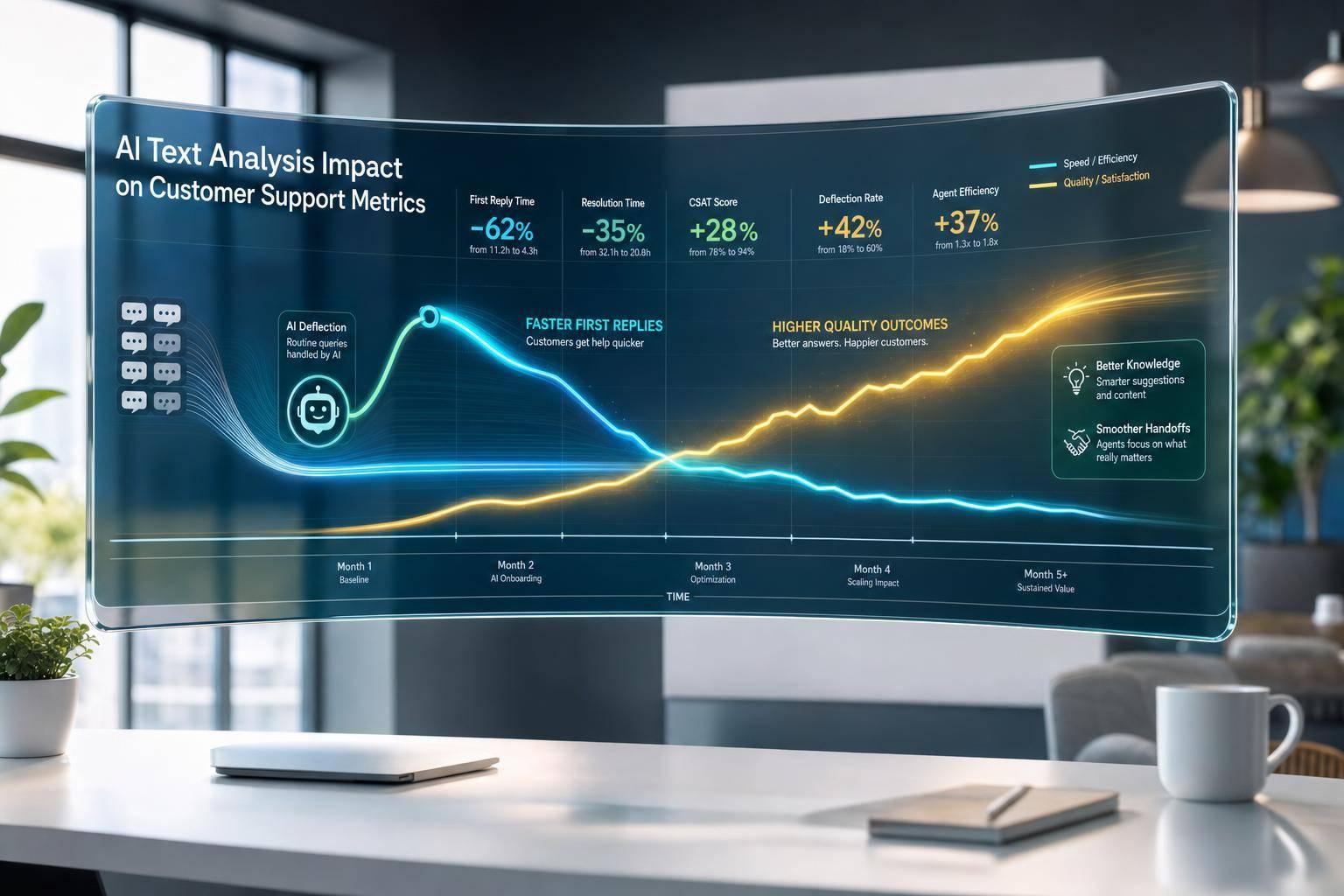
AI text analysis usually moves support metrics in this order: first response time first, then ticket handling volume, then customer-facing quality scores. In the article, I see the clearest pattern in faster first replies, better triage, and fewer routine tickets going to agents. The reported numbers are hard to ignore: some teams saw about 50% faster first responses and at least 50% deflection of routine queries.
If I had to boil the whole piece down, it would be this:
- Speed improves first. AI helps read messages, sort tickets, and draft early replies.
- Routing matters a lot. Intent detection and sentiment signals help send cases to the right queue.
- Quality takes more work. FCR and CSAT improve only when the system has the right knowledge and passes cases to humans without losing context.
- Deflection is not the same as resolution. A closed chat does not always mean the customer’s issue was fixed.
- Unreplied tickets matter. They are one of the clearest signs that service may be slipping.
Here are the main metrics the article focuses on:
- First response time (FRT): how long it takes to send the first useful reply
- Resolution time: how long it takes to close the case
- Resolution rate: how many issues get solved, including routine cases handled by AI
- First contact resolution (FCR): how many issues are solved in one interaction
- CSAT: how customers rate the experience after the case ends
My quick take: if you want to judge whether AI text analysis is working, start with response time, unreplied messages, resolution rate, and CSAT. Model scores alone do not tell you enough. What matters is whether customers get help faster and whether they still need to repeat themselves.
That’s the core idea the article builds on.
How to Build a Customer Satisfaction & Retention AI Agent
sbb-itb-e1b05dc
The Customer Support Metrics AI Text Analysis Affects
AI text analysis changes support metrics in a pretty direct way: it helps teams sort tickets faster, reply sooner, and pass cases to human agents with less friction. Speed tends to improve first. Quality usually takes longer, because the AI needs enough context to give complete, accurate help.
First Response Time, Resolution Time, and Resolution Rate
The first gains usually show up in speed and deflection.
First Response Time (FRT) is the gap between when a customer sends a message and when they get the first meaningful reply. AI text analysis can cut that gap by reading the message, pulling from the right knowledge source, and drafting an answer fast. In some deployments, first responses are about 50% faster [3].
Resolution Time tracks the full life of a ticket, from the first message to closure. AI can shorten this by handling early triage right away and making human handoffs smoother when an agent needs to step in.
Resolution Rate looks at the share of queries resolved successfully, including routine requests handled without a human. In live workflows, AI can deflect at least 50% of routine queries away from human agents [1][3].
First Contact Resolution and CSAT
The metrics above lean toward speed and volume. First Contact Resolution (FCR) and CSAT say more about quality.
FCR is the percentage of issues solved in one interaction, with no follow-up. This metric is tougher to move unless the AI understands the request in context and can pull the right knowledge to answer the whole thing, not just part of it.
CSAT (Customer Satisfaction Score) is usually gathered through a short survey after the ticket closes. It reflects the customer’s full experience, including whether the AI-to-human handoff felt smooth or messy.
Comparison Table: How Each Metric Is Measured in Studies
| Metric | What It Measures | Why AI Text Analysis Affects It | Typical Evidence in Studies |
|---|---|---|---|
| First Response Time | Time to the first meaningful reply | AI pulls information from knowledge bases and replies fast | Before/after response time averages; % reduction |
| Resolution Time | Total time from first message to closure | AI provides instant triage and can support 24/7 coverage | Mean handle time comparisons across cohorts |
| Resolution Rate | Share of queries resolved successfully, including routine cases | AI handles repetitive queries and cuts human ticket volume | AI-resolved vs. human-escalated ticket ratios |
| First Contact Resolution | Issues resolved in one interaction, without follow-up | Better context and knowledge retrieval can cut back-and-forth | FCR rate before and after AI deployment |
| CSAT | Post-interaction customer satisfaction score | It reflects the overall experience, including handoff quality | Survey scores tied to AI-handled vs. human-handled tickets |
Taken together, these metrics show whether AI is making service faster, lowering agent workload, or helping solve issues more cleanly. Ticket-level metrics show the outcome. Intent and sentiment data help explain why those numbers moved.
The next section looks at which of these metrics studies improve most consistently.
What the Research Shows About Metric Improvements
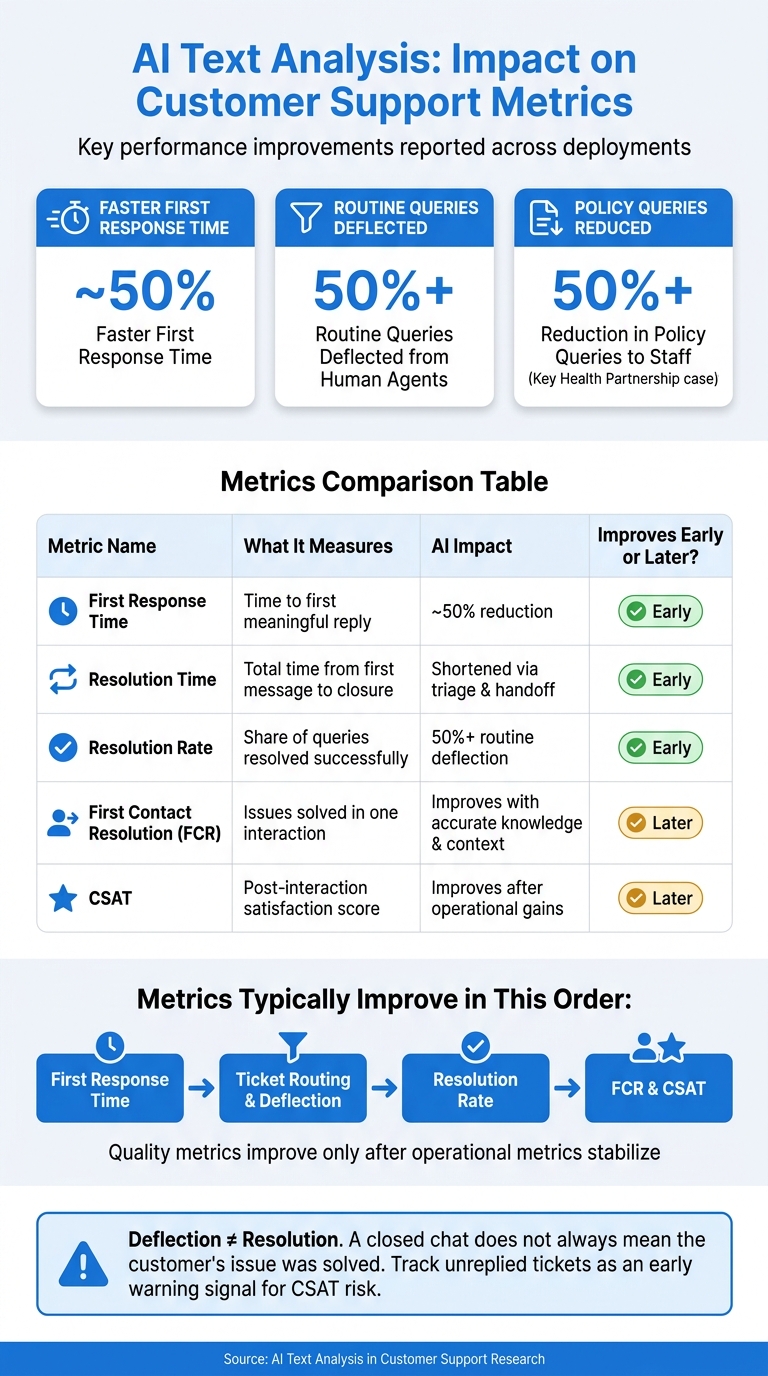
How AI Text Analysis Impacts Customer Support Metrics
Faster Response and Triage Outcomes
Research points to the clearest wins in first-response time. AI text analysis often cuts that metric by about 50% by automating triage and pulling answers from knowledge bases [3].
The strongest results show up in high-volume, repeat questions like pricing, onboarding, policy clarifications, and basic troubleshooting. In those areas, AI deflects a similar share of queries away from human agents [1][3]. You tend to see that pattern in setups that automate first replies and support-team triage.
Real-time intent detection can also spot frustration or VIP status early, which helps teams route and escalate cases sooner. In plain English, the gains come from better routing, smarter prioritization, and more structured knowledge handling.
Changes in Resolution Quality and Customer Satisfaction
Resolution quality and CSAT tend to improve when the AI has accurate company knowledge and passes the case to a human without losing context [1][3].
That said, the results are less steady when the knowledge base has gaps or the handoff falls apart. Key Health Partnership trained an AI agent on company-specific product data and documentation, cutting policy queries to staff by at least 50% while preserving full conversation context on escalations [1].
Those results hinge on routing, knowledge access, and handoff design, which the next section covers.
How AI Text Analysis Improves Support Performance in Practice
Routing, Prioritization, and Human Handoff
AI text analysis improves support performance mostly at the front of the workflow. The main wins come from shorter triage, better routing, and smoother escalation.
Real-time intent detection can send each message to the right queue before a human even steps in. Sentiment analysis helps flag frustrated customers or high-value accounts earlier. Frustration detection also cuts down on avoidable back-and-forth by moving tense conversations to escalation sooner. In practice, the biggest gains tend to happen before and during escalation, not after it.
Handoff is often where teams lose those gains. If context gets dropped, customers have to repeat themselves, resolution time goes up, and CSAT falls. Keeping the full conversation history and the right context at the moment of escalation helps stop that slide.
That leads to the next big factor: what the AI is actually able to read and use.
Where Structured Knowledge and Real-Time Analysis Matter
The quality of AI responses depends on well-organized product, policy, and onboarding knowledge. Real-time analysis works best when each agent operates within a defined knowledge scope. If confidence is low, or the question sits outside that scope, the system should pass the conversation to a human agent with context intact and conversation history preserved.
Key Health Partnership reported that integrating an AI agent reduced human-handled policy queries by at least 50% [1].
Here’s how each workflow stage connects to the metric it can affect:
| Workflow Stage | AI Text Analysis Mechanism | Impact on Metrics |
|---|---|---|
| Triage | Intent detection & classification | Faster First Response Time |
| Routing | Auto-assignment based on contact identity or query type | Higher Resolution Rate |
| Prioritization | Sentiment analysis & VIP tagging | Higher CSAT for priority customers |
| Escalation | Context-aware human handoff | Shorter Resolution Time; higher FCR |
These stages also explain why support teams should watch unreplied tickets, not just queue volume. Unread tickets can look bad, sure. But unreplied tickets are the earlier warning sign that CSAT may be at risk [2].
Even then, results will vary based on data quality, workflow design, and how the team measures performance.
Study Limits, Caveats, and Key Takeaways
What Studies Can and Cannot Prove
After the speed and routing gains above, the next step is to look at what studies are actually measuring.
A lot of studies report model accuracy. That number matters, but on its own, it doesn't tell you what happened for the customer. A high score on a model test is not the same as fixing a person's problem. Deflection is not resolution; close a conversation only when the issue is actually solved [2].
"Unreplied messages have higher importance than unread messages since a message can easily be read with no action required... however an unreplied message will always need attention." - Converso Product Documentation [2]
That line gets to the heart of it. If a message is still unreplied, work is still sitting there. That's why unreplied messages are one of the clearest signs that something still needs attention.
This is also why the most useful metrics tend to be operational, not just model-level scores. You want to know what changed in the queue, in the workflow, and for the customer.
Conclusion: Which Metrics Are Most Likely to Move First
The first numbers most teams see move are response time and initial triage [3]. Put simply, the early wins usually look like faster answers and less volume handled by AI agents.
Resolution quality and CSAT usually improve only after those operational metrics get better, not just because model scores went up [1] [3].
So the priority is pretty simple:
- Measure customer outcomes first
- Treat model accuracy as a supporting signal
- Track first response time, unreplied messages, resolution rate, and CSAT alongside model performance
FAQs
Which support metric should I track first?
Track First Response Time (FRT) first. It’s the clearest early sign that AI text analysis is doing its job. Research shows gains of up to 37%, cutting response times from more than six hours to less than four minutes.
Once you’ve set an FRT baseline, look at ticket resolution time, first contact resolution (FCR), and CSAT. Those metrics help you check whether speed is improving without hurting service quality or the customer experience.
How can I tell if deflection is actually helping customers?
Track deflection rate along with your quality signals. A good deflection rate - often 40% to 60% within six months - should line up with healthy escalation and error rates.
You should also start to see productivity gains as your team spends less time on repetitive questions and more time helping customers with harder issues. Conversation trends and sentiment can help show whether problems are being resolved the right way.
Why do CSAT and FCR improve more slowly than response time?
Response time tends to improve fast. AI can send instant, 24/7 acknowledgments and automated replies, which cuts wait times right away.
CSAT and FCR usually move more slowly. They depend on how well issues are resolved and how accurate the answers are. And when questions get more complex or less repetitive, teams often need deeper context or a handoff to a person.
That means gains in these areas usually build bit by bit as AI gets tuned through conversation analysis and stronger knowledge integration.


.svg)
.svg)
.svg)
.svg)